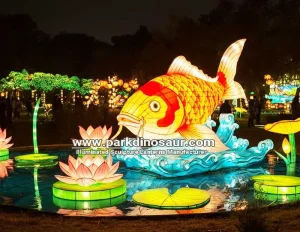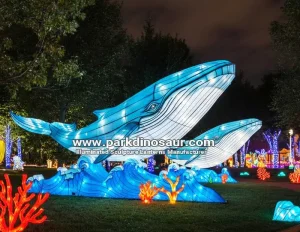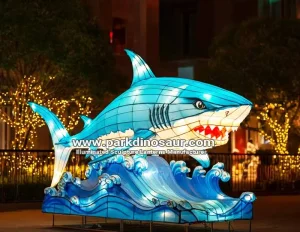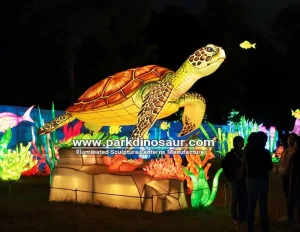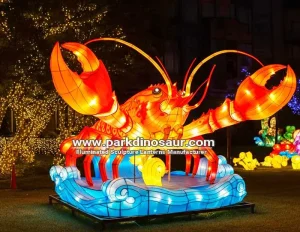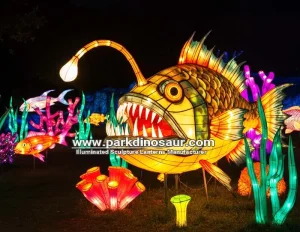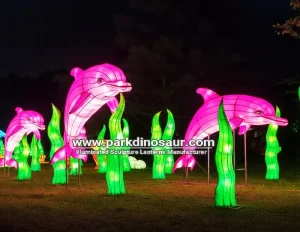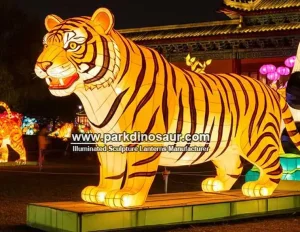
Nagoya Bay Series
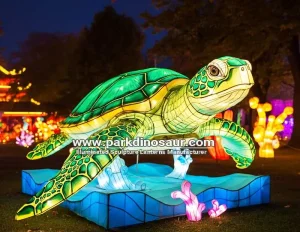
Fabricated according to stringent marine weatherproofing standards, our life-size aquatic lanterns integrate high-tensile internal steel frames, silk-translucent polymer textiles, and intelligent IP67 LED lighting systems.
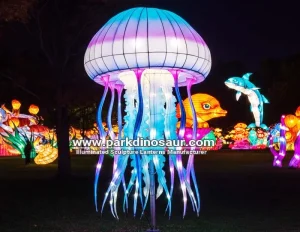
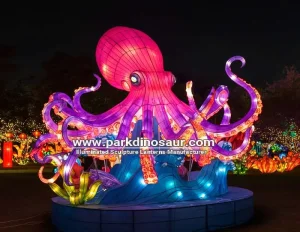
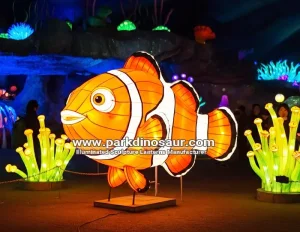
As the capital of Aichi Prefecture and the economic locomotive of Japan's Greater Chubu industrial corridor, Nagoya represents a crucial junction where cutting-edge industrial technology intersects with visionary waterfront development. Situated along the sheltered waters of Ise Bay, the Port of Nagoya is Japan’s largest and busiest commercial port by total cargo throughput. This unique logistical stature makes it a primary gateway for international exhibition structures, themed kinetic assets, and large-scale architectural illumination installations.
Within this regional landscape, attractions such as the Port of Nagoya Public Aquarium, the coastal recreational zones of Minato Mirai-style harbor redevelopments, and the seasonal light displays across Chubu Centrair and nearby Nabana no Sato have generated unprecedented institutional demand for marine life lantern installations. Municipal planners and commercial destination managers require specialized illumination products capable of enduring high humidity, coastal saline corrosion, and severe Pacific typhoon seasons without sacrificing sculptural intricacy.
Our operational framework bridges world-renowned Zigong lantern craftsmanship with Japan's rigorous industrial fabrication benchmarks. By managing structural load assessments against the Japanese Building Standard Law (Kenchiku Kijun-hō), our engineering team ensures all illuminated marine assemblies erected throughout Nagoya, Yokkaichi, and Toyota metropolitan peripheries deliver absolute safety and prolonged life cycles.
International destination developers, oceanarium operators, and public lighting curators evaluate aquatic lantern installations through complex operational metrics. Far beyond aesthetic novelty, enterprise procurement teams prioritize total cost of ownership (TCO), safety certifications, and biological authenticity.
Marine environments impose harsh thermal cycles, sodium aerosol degradation, and condensation accumulation. Global buyers require minimum IP66 to IP68 hermetic ingress ratings on all luminaire drivers, vulcanized silicone conduit transitions, and electrostatic epoxy coating across all internal structural joints.
Contemporary theme parks and municipal oceanariums demand scientific accuracy. Lantern structures are vetted by marine biologists to replicate authentic locomotion dynamics, correct fin placement in cetaceans, realistic cephalopod tentacle articulation, and bio-authentic luminescent color temperatures.
Logistical efficiency governs festival ROI. Global buyers enforce modular dimensional limits designed around standard 40ft High Cube shipping containers. Our sectional framing systems utilize quick-lock pin connections, pre-wired junction harnesses, and zero-weld field assembly protocols.
Delivering commercial durability across high-traffic public installations demands a total synthesis of ancestral artisanal shaping techniques with computer-aided finite element analysis (FEA) and modern materials science.
The foundation of every giant marine lantern begins with high-grade Q235 low-carbon structural steel. Rather than relying on simple planar wire layouts, master welders manually contour high-tensile solid round bars (6mm to 12mm) and hot-rolled seamless steel pipe frameworks over CAD-projected laser templates. This builds a 3D structural lattice capable of absorbing extreme dynamic wind buffeting without flex deformation.
Following multi-axis joint welding, the complete metallic skeleton undergoes an intensive tri-stage surface treatment: mechanical descaling, rust-inhibiting phosphating, and immersion hot-dip zinc galvanization, meeting ISO 12944 C5-M marine exposure parameters.
Traditional lantern silk degrades quickly when exposed to direct atmospheric UV radiation. Our fabrication protocol replaces raw silk with custom high-density nylon taffeta (density 190T-210T) treated with flammability inhibitors complying with NFPA 701 and Japan Fire Service Act flame-retardant standards. The fabric is heat-tensioned across the curved steel ribs using high-performance chloroprene rubber adhesives, eliminating surface sagging and moisture pockets.
Artists then execute micro-sprayed acrylic gradient shading across anatomical contours, sealing the pigments under an aliphatic polyurethane hydro-repellent clear coat that resists saline crusting and sun bleaching.
The future of cultural night tours and aquatic exhibitions is transforming toward autonomous, eco-responsive, and digitally augmented illumination frameworks.
Replacing static illumination with networked DMX512 and Art-Net controllers. Every oceanic exhibit features individually addressable RGBW modules, running algorithmic bioluminescent pulses, wave ripples, and interactive visitor-triggered kinetic responses via lidar and thermal camera inputs.
Developing 100% biodegradable bio-composite silk fabrics and water-based non-toxic binding resins. Incorporating ultrathin, flexible perovskite solar laminates directly on dorsal framework surfaces, enabling autonomous micro-grid illumination in off-grid coastal and lake habitats.
Integrating passive Bluetooth Low Energy (BLE) beacons and spatial computing markers into the structural lantern skeletons. Night-walk visitors in Nagoya can experience underwater augmented reality overlays, discovering virtual pelagic shoals swirling around the physical illuminated lantern core.
Operating commercial attractions within Japan necessitates adherence to strict structural and electrical safety protocols. As a seasoned industrial supplier servicing the Nagoya-Chubu regional sector, we deploy comprehensive engineering workflows to satisfy national and prefectural authorities.
From initial digital conceptualization and stress analysis to ocean freight booking into Nagoya Port and certified on-site rigging supervision, our bilingual technical managers offer comprehensive oversight. We assist municipal entities, commercial event contractors, and regional theme parks in securing all installation permits smoothly.
Direct engineering and logistical insights addressing common questions from venue owners, procurement agents, and exhibition producers.
Every internal steel component undergoes chemical phosphating and double hot-dip zinc galvanization complying with ISO 12944 C5-M industrial marine ratings. All internal wiring utilizes rubber-sheathed heat-resistant cabling inside flame-retardant conduit channels. Furthermore, all junction ports feature IP68 silicone compression glands and self-draining moisture weep valves along the lowest points of the structure.
A standard package consisting of 20 to 35 medium-to-giant lantern installations typically requires 30 to 45 business days for precision welding, skinning, artistic painting, and 72-hour burn-in testing. Ocean freight transit from manufacturing facilities directly to the Port of Nagoya typically takes 4 to 8 days, facilitating rapid seasonal turnaround.
Yes. While eastern Japan uses 50Hz, Nagoya and the Chubu region operate at 60Hz. Our control boxes and Mean Well power drivers are engineered with broad-spectrum input capabilities (90V-264V, 50/60Hz) and PSE compliance, ensuring steady current control without harmonic feedback or risk of transformer hum.
Yes. We engineer customized mechanical animatronic systems—including undulating manta ray wings, pulsing jellyfish bells, and opening whale jaws—using industrial brushless IP67 servo motors paired with high-torque planetary reduction gearboxes, all housed within completely hermetic dry enclosures.
Explore our specialized marine life product models. All installations are factory-direct, engineered for rapid modular assembly, and backed by comprehensive multi-year warranty coverage.